


A homeowner planning a front and back yard refresh in Beverly Hills usually starts with a moodboard: three or four photos of Mediterranean gardens, maybe a native planting scheme they saw at a friend’s house, a request that it read lush rather than sparse and skip the lawn that browns out every August. What often catches them off guard is that none of those photos matter yet. Before a plant list gets finalized, the project has to clear a water budget calculation and an irrigation zoning plan, paperwork that a landscape professional prepares as part of the permit or rebate process, not something added after the planting is chosen.
California’s Model Water Efficient Landscape Ordinance, known as MWELO, requires every local agency in the state, Beverly Hills included, to adopt and enforce a water-efficient landscape ordinance at least as strict as the state’s own model. The California Department of Water Resources’ MWELO program page confirms the current version took effect January 2, 2025. In practice, that means the plant palette a Beverly Hills homeowner ends up with is downstream of a set of numbers: how much of the yard can be turf, how the irrigation valves have to be grouped, and how the total water allowance is calculated. Plant selection is the last decision in the sequence, not the first.

Why “Drought-Tolerant” Is a Compliance Category Before It’s a Style
MWELO does not apply to every yard. It is triggered by size. The state’s Final MWELO Text and Appendices sets the threshold at an aggregate landscape area of 500 square feet or more for new construction, and 2,500 square feet or more for a rehabilitated (renovated) landscape. Most Beverly Hills projects, front and back yards combined on a typical residential lot, clear that bar without much effort.
Once a project is in scope, there are two ways to comply. The prescriptive path is a fixed checklist: specific turf limits, mulch depth, irrigation equipment standards, and a required share of low-water plants, all spelled out in advance. The performance path, sometimes called the water budget path, instead sets a maximum water allowance for the whole property and lets the designer meet it however the design calls for, denser native planting in one zone offset by a small accent lawn in another, for instance. Larger or more custom Beverly Hills projects usually use the performance path because it allows more design flexibility, but it also requires the calculation described in the next section to be run correctly.
The Water Budget Calculation That Actually Sets the Plant List
The performance path’s central number is the Maximum Applied Water Allowance, or MAWA. Per the DWR’s own MWELO guidebook on the landscape and irrigation water budget, MAWA is calculated from the local reference evapotranspiration rate, a 0.62 unit-conversion factor, and the landscape area weighted by an Evapotranspiration Adjustment Factor, or ETAF. MWELO sets that ETAF at 0.55 for residential landscapes, 0.45 for non-residential landscapes, and 1.0 for what the ordinance calls Special Landscape Areas, a category that includes recreational lawn, edible gardens, and features using recycled water. In plain terms: a residential yard’s water budget is capped at just over half of what an unrestricted, all-turf landscape would use, and every plant choice either spends or saves against that number.
That number is only usable once every plant on the palette has a rating. California uses the Water Use Classification of Landscape Species, or WUCOLS, published by UC Davis under the California Center for Urban Horticulture, to assign each species a water need factor from “very low” through “high” across the state’s climate zones. Under the prescriptive path specifically, at least 75 percent of a residential project’s plant area has to use species rated at a WUCOLS factor of 0.3 or lower, the boundary between the “low” and “moderate” categories. That single number is what actually filters a plant list long before anyone debates whether a specific shrub looks right against a specific facade.
How Much Lawn Beverly Hills Actually Allows
Turf is the line item clients ask about most directly, usually as “can we keep any lawn at all.” Under the state’s prescriptive compliance standard, reproduced in Carson, California’s MWELO prescriptive compliance requirements document as it is in every jurisdiction that adopts the state model, turf may not exceed 25 percent of the landscape area in residential projects, and is prohibited outright in non-residential landscapes. Turf is also barred on any slope steeper than a 1-foot vertical rise per 4 feet of horizontal run, roughly a 25 percent grade, and in parkway strips (the planted area between sidewalk and street) narrower than 10 feet.
That slope rule matters more in Beverly Hills than the raw percentage does. A meaningful share of hillside and canyon lots already exceed a 25 percent grade across some portion of the property, which means turf is excluded there by the terrain itself before the ordinance’s 25 percent cap is even relevant. On flatter Beverly Hills flats lots, the 25 percent cap is the binding constraint instead, and it usually lands as a modest lawn panel off a family room or pool deck rather than a wall-to-wall front lawn.
Irrigation Zoning: The Detail That Fails Projects After Installation
Plant selection gets the design attention. Irrigation zoning is where compliant-looking projects actually go wrong, usually months after installation rather than at plan check. MWELO’s guidebook defines a hydrozone as a section of the landscape where plants with similar water needs are grouped into one irrigation zone served by its own control valve, and it states the rule plainly: plants with a high water factor and plants with a low water factor are not allowed on the same hydrozone or valve. Mixing a rose bed and a manzanita planting on one valve, a common shortcut when a contractor wants to minimize the number of zones on a controller, means one of the two is being watered wrong on any given schedule. Either the manzanita gets overwatered into root rot, or the roses go thirsty.

The prescriptive standard adds equipment specifics on top of the hydrozone rule: any spray or rotor irrigation heads installed have to document a distribution uniformity of 0.65 or higher, planted areas narrower than 10 feet need subsurface drip or another no-runoff system rather than overhead spray, and controllers must be automatic, weather-based units that adjust to evapotranspiration or soil moisture data and shut off during rain. None of this is visible in a finished photo. It shows up eighteen months later as a dead hedge on one side of a valve and an overgrown, root-bound one on the other, which is why irrigation zoning belongs in the same design conversation as the plant list, not handed to whichever installer is cheapest.
Building a Plant Palette That Reads Considered, Not Sparse
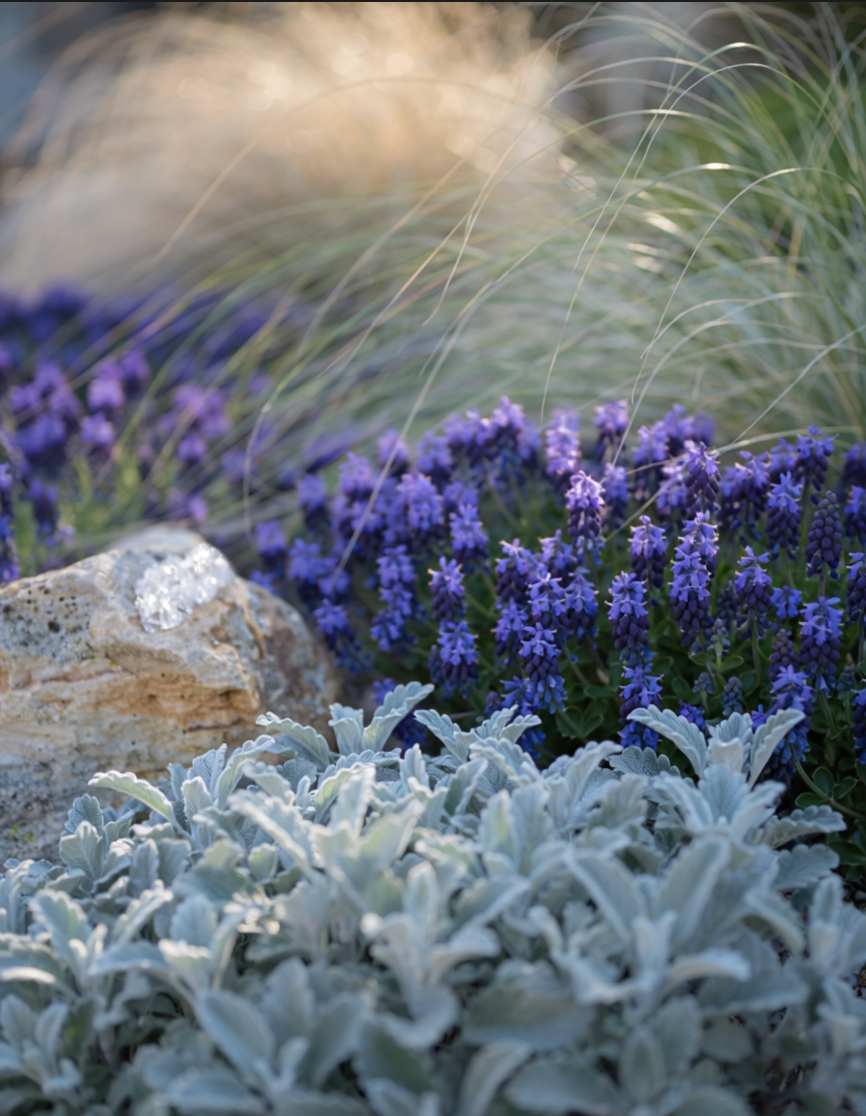
The most common objection to a water-wise landscape is aesthetic: a worry that “drought-tolerant” means gravel, a few succulents, and not much else. WUCOLS’ “very low” and “low” categories cover a much wider range than that, from silver-leaf Mediterranean shrubs and flowering ceanothus to olive and oak canopy trees and ornamental grasses like Muhlenbergia, all of which can be layered the same way a higher-water planting scheme would be: a canopy layer, a structural shrub layer, a textural grass layer, and a smaller accent layer for seasonal color.
The Theodore Payne Foundation, a Los Angeles-based nonprofit whose stated mission is supporting the use of native plants in urban horticulture, is one of the reference points regional designers use for straightforward, regionally appropriate native species rather than plants pulled from a national low-water list that may not actually perform in the Los Angeles basin’s specific soil and marine-layer conditions. Pairing a native backbone with a handful of Mediterranean specimens (olive, rosemary, lavender) tends to read as intentional and layered to a client, closer to a Provençal or coastal Italian garden than a xeriscape lot.
Two prescriptive-path requirements support that layered look mechanically rather than just aesthetically. A minimum three-inch mulch layer is required on all exposed soil, which both conserves moisture and reads as a finished bed rather than bare dirt, and compost has to be incorporated at a rate of at least four cubic yards per 1,000 square feet to a six-inch depth before planting, which meaningfully improves how well natives and Mediterranean species establish in Los Angeles’s often compacted or clay-heavy soils, per the same MWELO prescriptive compliance requirements cited above.
Where Hardscape Fits: The City’s Own Rule Behind the State Rule
A common assumption is that MWELO itself caps how much of a yard can be paved versus planted. It does not; the state ordinance’s text does not set a fixed hardscape-to-planting ratio. What actually limits hardscape coverage on a Beverly Hills front yard is the city’s own municipal code, not the state water ordinance. Beverly Hills Municipal Code section 10-3-2423 requires that “all unpaved portions of a front yard shall be improved and maintained with landscaping,” and a landscaping plan for a new single-family residence has to be designed to maintain what the code calls the city’s “garden quality.” That is a local, aesthetic requirement layered on top of, and separate from, the state’s water-use rules.
Beverly Hills’ code also shapes how a water feature or irrigation schedule gets designed. Municipal Code section 9-4-201, on permanent water use restrictions, limits outdoor landscape irrigation to the hours of 5:00 PM to 9:00 AM, prohibits water running off onto a sidewalk, street, or neighboring property, and requires that decorative water features such as fountains or ponds recirculate rather than run on fresh potable water. A fountain or reflecting pool worked into a hardscape plan has to be designed as a recirculating feature from the start, not retrofitted later to satisfy the code.
Rebates, Costs, and Coordinating the Budget
Cost data from Angi’s 2026 xeriscaping cost figures puts professional drought-tolerant landscape installation at roughly $5 to $20 per square foot, with a typical whole-yard project landing between $5,000 and $24,000 and averaging around $17,000. On a Beverly Hills-scale property with mature specimen trees, boulder work, and a full irrigation retrofit, costs commonly land toward the higher end of that range or above it.
Turf replacement rebates can offset part of that cost across much of the Los Angeles area. LADWP’s turf replacement rebate pays residential customers $5 per square foot, up to 5,000 square feet or a $25,000 maximum, for projects of at least 250 square feet that include California Friendly or native plants, mulch or groundcover, a rain-capture feature, and drip irrigation, with a five-year compliance period and required pre-approval before work begins. Beverly Hills operates its own municipal water utility rather than buying water and administering rebates exclusively through LADWP, so a Beverly Hills homeowner should confirm current rebate terms directly with the city’s Public Works Department rather than assume LADWP’s figures apply on their own property; the LADWP program above is representative of what is available to much of Point Of Design Studio’s broader Los Angeles client base outside Beverly Hills proper.
A five-year rebate compliance period is also a reason to have one team carry the water budget calculation, the hydrozone plan, and the planting and hardscape design together, rather than splitting the work across a plant nursery, a separate irrigation contractor, and a hardscape crew who each make decisions that have to reconcile on one valve schedule and one water budget number. Point Of Design Studio’s exterior design and architectural design teams coordinate that submittal as one package, and can extend into interior design when a project runs indoors as well, under Creative Director Nina Avetisova, who has more than 18 years of residential design experience across Europe and the United States. That is one reasonable way to staff a compliance-heavy landscape project. A homeowner with a smaller, already-compliant yard may be equally well served hiring a landscape architect directly for the water budget paperwork and a separate licensed contractor to build it. See about, residential projects, or contact us.
Frequently Asked Questions
Does drought-tolerant landscaping in Beverly Hills have to follow MWELO?
Yes, for any new landscape project of 500 square feet or more, or a rehabilitated landscape of 2,500 square feet or more. California requires every local agency, including Beverly Hills, to adopt and enforce a water-efficient landscape ordinance at least as strict as the state’s Model Water Efficient Landscape Ordinance, most recently updated effective January 2, 2025. Smaller projects can fall outside the formal size thresholds, but Beverly Hills’ own municipal water-use restrictions still apply regardless of project size.
How much lawn can I keep under a water-wise landscape design in Los Angeles?
Under MWELO’s prescriptive compliance standard, turf is capped at 25 percent of the landscape area in residential projects, and is not allowed on slopes steeper than a 1-foot rise per 4 feet of horizontal run or in parkway strips narrower than 10 feet. A design using the water budget (performance) path instead of the prescriptive checklist has more flexibility in exactly where turf goes, but still has to hit the same overall water allowance number.
How much does drought-tolerant landscaping cost in Los Angeles?
Industry cost data puts professional xeriscape and drought-tolerant landscape installation at roughly $5 to $20 per square foot, with a typical whole-yard project landing between $5,000 and $24,000 and averaging around $17,000. Site prep, boulder and hardscape work, mature specimen plants, and irrigation controller upgrades push a larger residential project toward the higher end of that range or above it.
Do I need a landscape architect to comply with MWELO on a Beverly Hills project?
Not always, but for anything beyond a small prescriptive-path project, it helps. A landscape architect, or a design-build team with one on staff, is typically who runs the water budget calculation, prepares the hydrozone and irrigation plan, and signs the compliance documentation a Beverly Hills project may need to submit. A homeowner doing a small refresh that falls below MWELO’s size thresholds may not need one at all.
Are there rebates for replacing lawn with drought-tolerant landscaping in Los Angeles?
Yes, in much of the Los Angeles area. LADWP’s turf replacement rebate pays residential customers $5 per square foot, up to 5,000 square feet or a $25,000 maximum, for projects of at least 250 square feet that include California Friendly or native plants, mulch, a rain-capture feature, and drip irrigation, with a five-year compliance period and required pre-approval. Beverly Hills operates its own municipal water utility rather than buying water exclusively through LADWP, so Beverly Hills homeowners should confirm current rebate terms directly with the city’s Public Works Department rather than assume LADWP’s figures apply.